
Science
Fusion Energy News
Community-owned · Subscriber-funded · No ads
Monday, September 14, 2026
Vol. III · August 2026
Science · high impact
The Breeder That Starves the Turbulence
Gyrokinetic simulations run in CGYRO, General Atomics' turbulence code, place Kronos Fusion Energy's Hyperion breeder at an operating point below the threshold where core turbulence grows — a confinement regime distinct from the machines leading the field today.
Reported fusion metrics
Fusion gain (design point)
Q 3.076
85 MW fusion power, Hyperion breeder
Plasma current
9.66 MA
carried without a central solenoid
Transport reduction
~40% ion / ~80% electron
CGYRO at real electron mass
Engineering gain (D–3He mirror)
Q_E 1.318
Aegis / MetroVolt tandem mirror
The hardest problem in magnetic fusion is not heat, or pressure, or even magnets. It is turbulence. In almost every tokamak, small eddies grow, tangle, and ferry heat out of the core faster than the machine can pour it back in, and a great deal of modern fusion engineering is a fight to slow that leak. Kronos Fusion Energy's Hyperion breeder is designed to do something more radical than slow it: it sits at an operating point where the dominant core turbulence does not grow at all. That result, computed in CGYRO, the gyrokinetic code developed at General Atomics, is the scientific heart of the machine.
Turbulence has a switch. Below a certain steepness in the plasma's temperature profile, the eddies never form; above it, they grow and start bleeding heat out of the core. Almost every fusion machine operates above that switch — by the time the plasma is hot enough to be useful, it is already turbulent — and the engineering job becomes holding the leak down to something a reactor can live with. The high-field deuterium–tritium tokamaks leading the private race, the ARC and SPARC line, hold it back with powerful magnets and a high-confinement H-mode edge. The spherical tokamaks — the UK's STEP program, Tokamak Energy's ST40 — do it with their own shaping and current. All of them are managing turbulence that has already switched on. Hyperion is designed to sit below the switch: the turbulence never starts, so there is nothing to hold back.
Below a certain steepness in the plasma's temperature profile, the eddies never form; above it, they grow and start bleeding heat out of the core.
Confinement by geometry. Hyperion reaches for confinement with shape rather than sheer field. The shape in question is negative triangularity — a plasma cross-section bent to point the wrong way relative to a conventional D-shaped tokamak. Negative triangularity has a track record in the experimental literature, on machines like TCV and DIII-D, of delivering H-mode-like confinement without the H-mode: no pedestal, and none of the edge-localized bursts that come with it. In the CGYRO runs, negative triangularity combined with flow shear suppresses turbulent transport on the order of 40 percent at the ion scale and 80 percent at the electron scale, and drives the chosen operating point below the threshold where turbulence becomes self-sustaining. A subcritical core, in the language of the field: not turbulence fought to a draw, but turbulence that never gets going.
What makes the result more than a hopeful curve is the fidelity of the calculation. Turbulence modeling is notorious for cheating on the electrons — the lightest, fastest species, and the most expensive to resolve — by giving them an artificial mass. The Hyperion stability map was computed at real electron mass, the setting under which electron-scale transport actually shows up, and the operating point stays subcritical across it. That is the number the entire breeder design rests on, and the basis for placing its confinement ahead of machines built on the prevailing approach, in which turbulence is a tax you pay and then work to minimize.
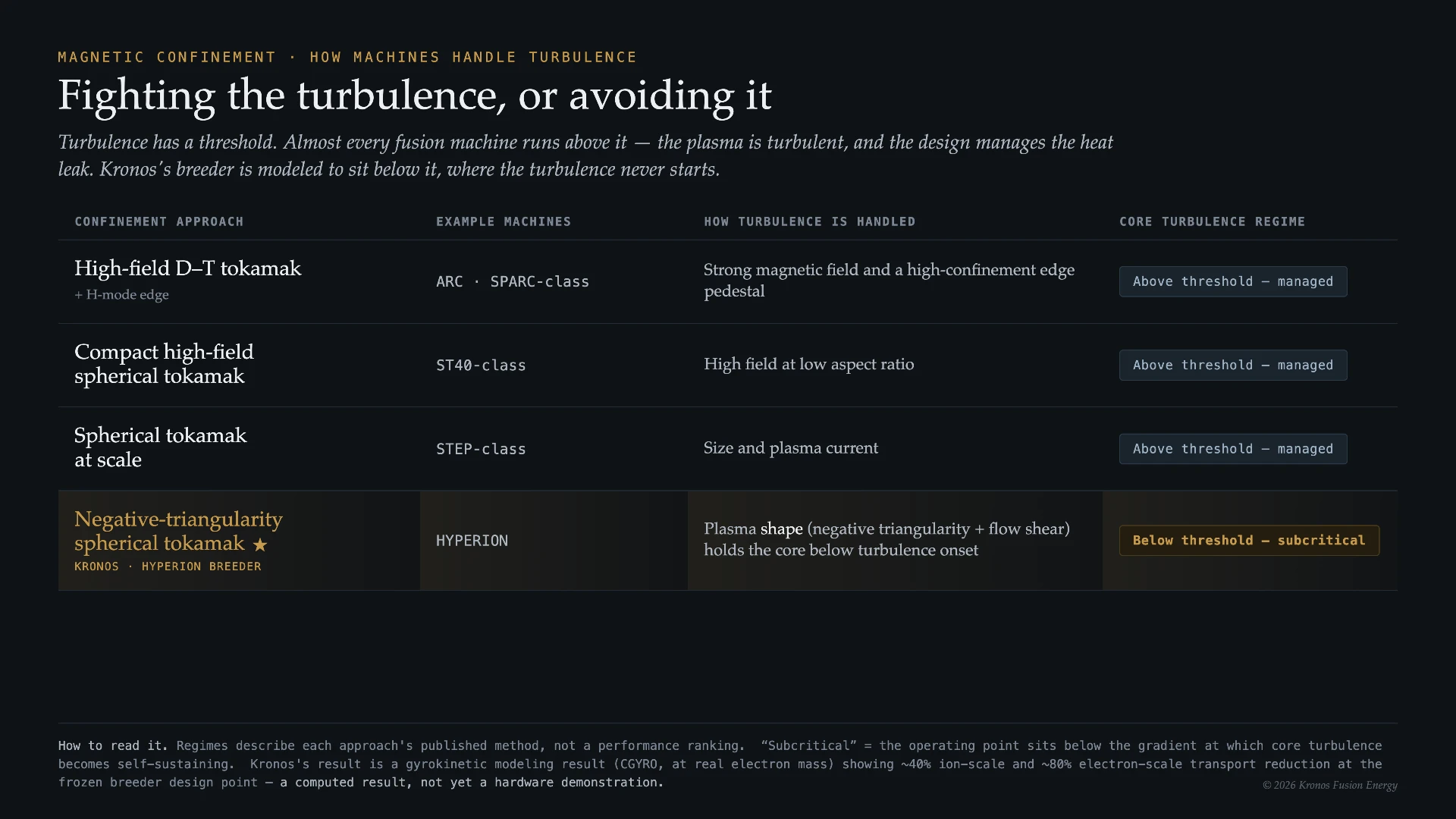
How magnetic-confinement machines handle core turbulence. High-field D–T tokamaks with an H-mode edge (ARC, SPARC-class) hold the leak back with a strong magnetic field and a high-confinement edge pedestal — above threshold, managed. Compact high-field spherical tokamaks (ST40-class) use high field at low aspect ratio — above threshold, managed. Spherical tokamaks at scale (STEP-class) use size and plasma current — above threshold, managed. Hyperion, a negative-triangularity spherical tokamak, uses plasma shape — negative triangularity plus flow shear — to hold the core below turbulence onset: below threshold, subcritical. The regimes describe each approach's published method, not a performance ranking.
Why the shape matters. A tokamak plasma has a D-shaped cross-section. In almost every machine the D points outward — its flat side to the inside, its curve toward the wall. Negative triangularity flips it, so the curve faces in. That small change in geometry reshapes the magnetic field the plasma sits in, and it weakens the drive behind the bad-curvature instabilities that seed core turbulence: the eddies that would grow in a conventional plasma find less to feed on. The effect is not only theory. On TCV in Switzerland and DIII-D in the United States, negatively-shaped plasmas have matched the confinement of the high-performance H-mode — without the pedestal, and without the violent edge bursts it throws off.
What the quiet buys. Confinement is not the breeder's product, though — fuel is. Hyperion is a compact deuterium–tritium spherical tokamak run not as a power plant but as an isotope foundry, breeding tritium, helium-3, and 14-MeV neutrons, three materials in chronic short supply. Because its bar is fusion gain rather than net electricity, the design can spend its margins on staying quiet rather than on chasing a power balance it does not need. The result is a self-consistent operating point: a design gain of Q 3.076 at 85 megawatts of fusion power, 9.66 megaamps of plasma current carried without a central solenoid, and a breeding blanket whose tritium breeding ratio clears self-sufficiency — more tritium out than burned. Because the machine's product is materials rather than electricity, its physics basis is enough to justify construction; ground-breaking on Hyperion is set for 2027, on a four-year build.
The other machine. The breeder is only half the program. Its helium-3 by-product is the fuel for a second, very different device — a deuterium–helium-3 tandem mirror, offered as Aegis and MetroVolt, that trades the ring geometry for an open, linear trap and converts charged-particle energy directly to electricity rather than boiling water. D–3He runs far cleaner than D–T, carrying only a small fraction of its energy in neutrons, which is what makes direct conversion worth building around. Engineering gain there is put at Q_E 1.318, with the power case still turning on one open question: the efficiency of the end-plugging that holds the burn, a WHAM-class gate left in public rather than assumed away. Net electricity from that machine is roughly a decade off.
Closed, and checkable. The thread running through the program is a single unglamorous proposition: that the physics is closed. Every number lands on one frozen operating point, and each is a named, dated computation rather than an extrapolated scaling law — the confinement from a CGYRO run, the gain from a power balance, the breeding ratio from a neutronics ensemble. The misses sit alongside the wins, and no machine in the program makes net power today; the remaining distance is engineering. But the confinement result is the one a physicist will stop on. If it holds in hardware, a compact breeder that runs its core subcritical would reach the confinement the leading machines are chasing — and reach it by a different, lower-field road. The field can check it now, because the design basis for both machines is posted in the open at kronosfusionenergy.com/open-science.
Editor's note: the figures above (Q 3.076, Q_E 1.318, ~40%/80% transport reduction) are frozen design-point values from Kronos Fusion Energy's published physics basis. The confinement result comes from gyrokinetic simulation in CGYRO (General Atomics) at real electron mass, not a hardware demonstration. Reference machines are grouped by published approach and are not ranked.
Reporting grounded in coverage from the original publisher — read the source .
Weekly newsletter
Fusion Energy Weekly
The week in fusion: breakthroughs, companies, and capital — in your inbox. Free, every Monday.
Primary sources
Editorial standards: Fusion Energy News dispatches are compiled from primary filings, peer-reviewed papers, and on-the-record statements. Corrections: corrections@fusionenergynews.com · public log
More on Science
Letters to the editor(0)
Sign in to write a letterNo letters yet. Be the first to write one.